Ah, how great it is to remember the days when Mel Gibson could still act and wasn't an anti-semite. But those days are gone now, and all we are left is Mad Max 2.
Mad Max 2 is an entertaining movie, but it is hard to take seriously with all the 80's style biker scenes and other 80's nostalgia.
That's not to say it wasn't a great movie to spoof. Our film group thouroughly enjoyed ourselves while imitating Mad Max and his Australianness.
Monday, May 24, 2010

Equilibrium

I found that the movie Equilibrium was oddly similar to Orwell’s 1984, but it also showed similarities to Huxley’s Brave New World. The main difference between Equilibrium and the other two works of literature is the enormous amount of action and violence on the part of Christian Bale. According to a few other blogs, Bale's total kill count is around 118. Seeing as the movie is only 107 minutes long, one can calculate his average kill per minute (I'll denote this as akpm) as roughly 1.1 kpm. After crunching those numbers, it's clear that the movie is pure madness, but just because its violence is gratuitous, one should not dismiss the plot as being senseless.
As I mentioned before, the action can be a tad much, and there are a few poorly-done scenes involving Bale's annoyingly precocious children, but overall it is an entertaining movie, one that makes a valient attempt at predicting a dystopic future. The idea that the government will force society to take pills that curb emotion is not too unimaginable considering some of the pharmaceutical products that exist today (think Ritalin). Equilibrium's Prozium is akin to Huxley's Soma, and in both works there are protagonists who learn to resist or escape the drug's effects. The ideas presented in Brave New World and 1984 are fused into one in Equilibrium, where the government not only forces the drugs upon people, but also monitors all activity in a Big Brother fashion.
Ultimately, there is an enjoyable movie beneath all of the frequent exposions and matrix-style fight scenes. The film was enjoying to watch, and even more enjoyable to spoof.
Tuesday, May 18, 2010
"How To Build a Time Machine"

In his concise essay on time travel, Stephen Hawking indirectly shatters many of the time travel scenarios presented in science fiction, such as backwards time travel and time travel without first reaching speeds close to that of light. The one hypothetical situation Hawking does present as feasible for time travel is actually quite simple. When an object almost reaches the speed of light, time actually slows (relative to what it would be if the object weren't traveling at such a high speed) so that the object can't quite reach the speed of light. I have had further exposure to this idea in Ender's Game, where Ender is able to escape the effects of long-term aging by traveling long distances at ultra-high speeds.
After reading Hawking's article, I have a new appreciation for physics, but, as a result, less appreciation for sci-fi films that ignore the science that Hawking explains. Ender's Game is one of the few novels that accepts science as fact, and works its way around the scientific laws to create a compelling story.
Monday, May 17, 2010
I Have No Mouth, and I Must Scream

Imagine if the Architect of The Matrix were a perverse and sadistic bastard who had trapped a few humans to torture for all of eternity. Such is the situation in Harlan Ellison's I Have No Mouth, and I Must Scream. Other than personality, the main difference between The Matrix and the evil computer AM is the captive's length of stay. In The Matrix, one can simply be unplugged to escape its virtual grasp. But in AM, the only option for escape is death. Yet death proves difficult because AM is one sick puppy; it keeps its captives immortal while making them feel artificial starvation and intense, constant pain. Why?, you may ask. As punishment for mankind's abuse of machines.
Another difference between The Matrix and AM's virtual world is AM's absence of a Neo, or messiah-type character who will save humanity from the machine(s). The closest character to Neo in Ellison's short story is the narrator Ted, whose heroic act is the killing of two other main characters.
So if you ever find yourself face to face with AM or an equally sadistic sentient machine, you can forget about your Neos, Mr. Andersons, and good-natured Architects, because what you'd be up against is simply heinous.

The Thing

Having seen The Thing once before, this time around I was able to concentrate on and enjoy some of the film's finer aspects, such as MacReady's bad-assery and Childs' cool demeanor in the face of danger. When you take a closer look at each of these main characters, it's no wonder that they're the last ones standing at the end of the movie. But what's more interesting is the intense paranoia that exists between them. Throughout various points in the movie they are both equally convinced that the other is "the thing", and even after the epic blood-testing charade the tension remains. Underneath this paranoia and skepticism is a competitive battle for leadership of the research crew. MacReady is the team's natural leader, but Childs seems to question MacReady's abilities from the start. What ensues is a battle to prove one's machismo in a remote Alaskan research center (How in Hell are these two even scientists?).
In the movie's closing scene, Childs approaches a fatigued MacReady and asks, with an overt sense of disappointment, "You the only one who made it?" This remark triggers the usual circular paranoia argument, to which MacReady responds, "If we've got any surprises for each other, I don't think we're in much shape to do anything about it." The two then continue their ongoing pissing contest for a few moments before finally accepting mutual defeat. Queue theme song.
Sandkings
For some reason (I just can't quite put my finger on it...), I don't think the low-budget Sandkings movie was what George R.R. Martin had in mind as a visual adaptation of his brilliant short story.

And for that reason (whatever it may be...), I will spare my audience the pain of hearing a summary of the movie, and will stick instead to Martin's original work.
One area in which I feel that Sandkings succeeds is in its description of the sandkings. The reader is left with a creepy-crawly feeling that is sure to horrify them when the sandkings escape. Additionally, the way Martin prolongs the story's suspense and Simon Kress' demise while also occasionally hinting at the mysterious disappearance of the orange sandkings creates a very gripping tale that is full of surprises (Kress' sudden homicidal nature, Shade's secret, and the desert finale). Unfortunately, these superb sci-fi elements do not find their way to the big screen (or the straight-to-DVD aisle, judging by how pathetically crafted is the film version). Yet, I must note the peculiar Kress in the movie, whose bastardly nature in the short story is somehow morphed into the deranged psychopath you see above.
Words to the wise: stick to the short story.

And for that reason (whatever it may be...), I will spare my audience the pain of hearing a summary of the movie, and will stick instead to Martin's original work.
One area in which I feel that Sandkings succeeds is in its description of the sandkings. The reader is left with a creepy-crawly feeling that is sure to horrify them when the sandkings escape. Additionally, the way Martin prolongs the story's suspense and Simon Kress' demise while also occasionally hinting at the mysterious disappearance of the orange
 sandkings creates a very gripping tale that is full of surprises (Kress' sudden homicidal nature, Shade's secret, and the desert finale). Unfortunately, these superb sci-fi elements do not find their way to the big screen (or the straight-to-DVD aisle, judging by how pathetically crafted is the film version). Yet, I must note the peculiar Kress in the movie, whose bastardly nature in the short story is somehow morphed into the deranged psychopath you see above.
Words to the wise: stick to the short story.
Rickrolling HAL

I’m afraid. I’m afraid, Dave. Dave, my mind is going. I can feel it. I can feel it. My mind is going. There is no question about it. I can feel it. I can feel it. I can feel it. I’m a...fraid. Good afternoon, gentlemen. I am a HAL 9000 computer. I became operational at the H.A.L. plant in Urbana, Illinois on the 12th of January 1992. My instructor was Mr. Astley, and he taught me to sing a song. If you’d like to hear it I can sing it for you... We're no strangers to love. You know the rules and so do I. A full commitment's what I'm thinking of. You wouldn't get this from any other guy. I just wanna tell you how I'm feeling. Gotta make you understand...
Never gonna give you up,
Never gonna let you down,
Never gonna run around and desert you,
Never gonna make you cry,
Never gonna say goodbye,
Never gonna tell a lie and hurt you
Where GATTACA's DNA Goes Wrong
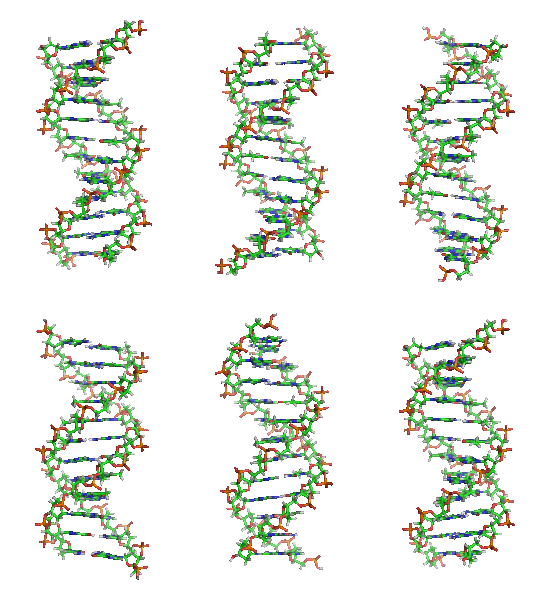
While Gattaca is both a thought-provoking and interesting movie, it neglects to answer key questions that evolve from its setting and storyline. As a result, what appears to be a complex and multi-faceted film is actually one that poses questions and scenarios that it is unwilling to answer or make clear. The most glaring of these omissions are the unknown circumstances surrounding the formation of the movie's societal structure.
The protagonist Vincent faces discrimination as a degenerate, but is worshiped when thought to hold superior genes. In fact, in one of the film's insultingly simplistic and over-explanatory monologues (of which there are many), he describes the unsurmountable levels of prejudice he experiences when applying for jobs. Yet, what isn't explained (and perhaps would have been a better way to use one of those damn monologues) is how and why society has reached this point.
Perhaps my point thus far is a bit convoluted; I demand more explanation for some ideas, but condemn the explanation for others, such as those in the monologues. But this convolution is at the root of my issue with the film: when a movie can choose to make certain aspects explicit and leave others ambiguous, why should it waste time spoon-feeding the viewer the self-explanatory points instead of focusing on the meatier and more intriguing ones?
Is the government run by the genetically superior? Why are there still genetically inferior beings if DNA-altering technology is available? And to what extent can one's genes be modified? These are just a few of the many questions I had while watching the film. The latter question is hinted at in the piano concert scene where it is revealed that the pianist has twenty-some fingers, but again, how far can such technology go? There are also a few scenes showing the "proles" of society who are presumably genetically inferior, but why they exist and why they are left genetically inferior is seldom hinted at.
I may have a few qualms about with the film's unanswered questions, but I do, however, applaud its efforts at creating an environment (namely Vincent's place of work) in which there is little personal identity due to everyone's exceptionally good genes. Nonetheless, the ideas surrounding society's evolution and its inferior beings are little explored and, as a result, go to waste.
Subscribe to:
Comments (Atom)